Postgres and Open Source Experts

Anytime. Anywhere. Since 1997.

Blog

When huge_pages Help: Using PSI to Find Bottlenecks Before You Decide

When huge_pages Help: Using PSI to Find Bottlenecks Before You Decide

Benchmarking huge_pages on a 128 GB PostgreSQL 18 system shows throughput gains are modest — but page table overhead at 4KB pages can consume up to 20% of total RAM. Use PSI to find where your system is actually stalling before making the call. Part 2 of 3.

PgColumnar 1.0Alpha2 released

Release date: 2026-08-18

Previous release: 1.0-alpha (2026-08-04)

pgColumnar is a columnar table access method for PostgreSQL. This is the second alpha. It adds read-only Apache Iceberg support, reads and writes over S3-compatible object storage, a maintenance daemon, and a broad round of statistics, planner, performance, and security work. The on-disk native format (PGCN v1) is unchanged; existing tables are read and written as before.

This release requires one …

Parquet and Iceberg: An Overview

A pile of containers is not a shipment. A shipment is containers plus a manifest.

Apache Iceberg is the manifest. It is not a file format, it is a table format: a metadata layer that records exactly which Parquet files make up a table at every point in time. That one idea buys you things we used to think required a warehouse. Transactions on object storage, so writers never corrupt …

Beyond the 25% Rule: shared_buffers Behavior in Large-Memory PostgreSQL

Beyond the 25% Rule: shared_buffers Behavior in Large-Memory PostgreSQL

Tuning shared_buffers isn't just about peak throughput — it's about how much CPU and disk I/O a system consumes per unit of work. The 25% default can require up to 5x more disk I/O than very low or very high allocation. Part 1 of 3.

What If Your Team’s Biggest Burnout Driver Lives in Your Database?

What If Your Team’s Biggest Burnout Driver Lives in Your Database?

Engineering leaders work hard to protect their teams from burnout — improving processes, hiring strong talent, and adjusting on-call rotations. But if your team still looks exhausted, the real issue may not be the rotation at all. It’s often the underlying database and infrastructure quietly triggering the same incidents over and over.

Why You Should Review Your Authentication Strategy

Why You Should Review Your Authentication Strategy

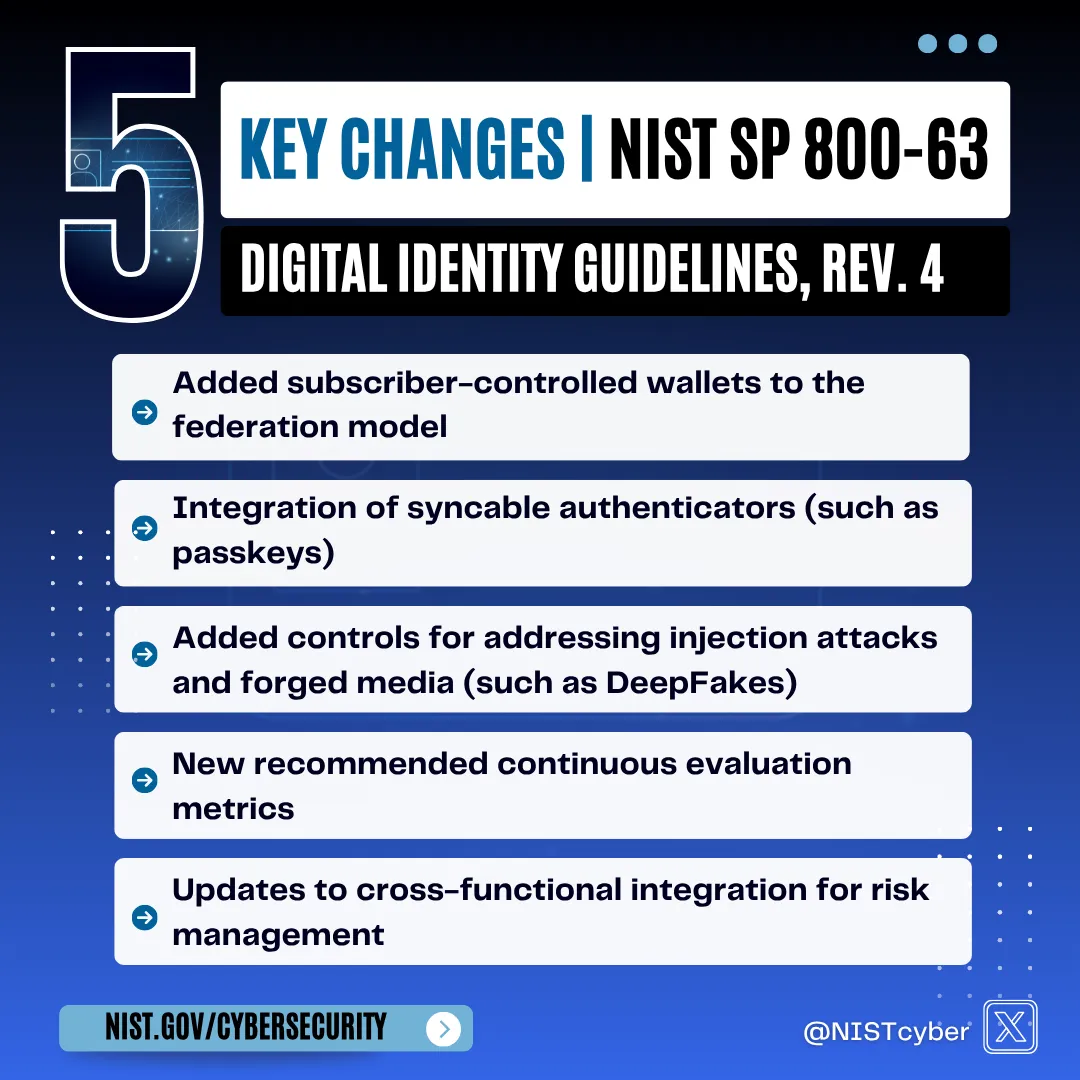
Released in July 2025, NIST SP 800-63 Revision 4 introduced new requirements for authentication strength, identity proofing, and federation security. Many organizations still haven't assessed their systems against these updated standards. Learn what changed, why it matters for compliance, and how to evaluate your current identity controls against the new framework.

PgManage 1.4 – SQL Server Support, Faster Interface Navigation, Spreadsheet‑like Data Grids & More!

PgManage now supports Microsoft SQL Server and includes numerous UI improvements and features intended to make your daily database work more efficient. See the blog post for a feature overview and insights into our decision‑making process.

PostgreSQL 18: Revolutionary Performance Boost Now Available

PostgreSQL 18: Revolutionary Performance Boost Now Available

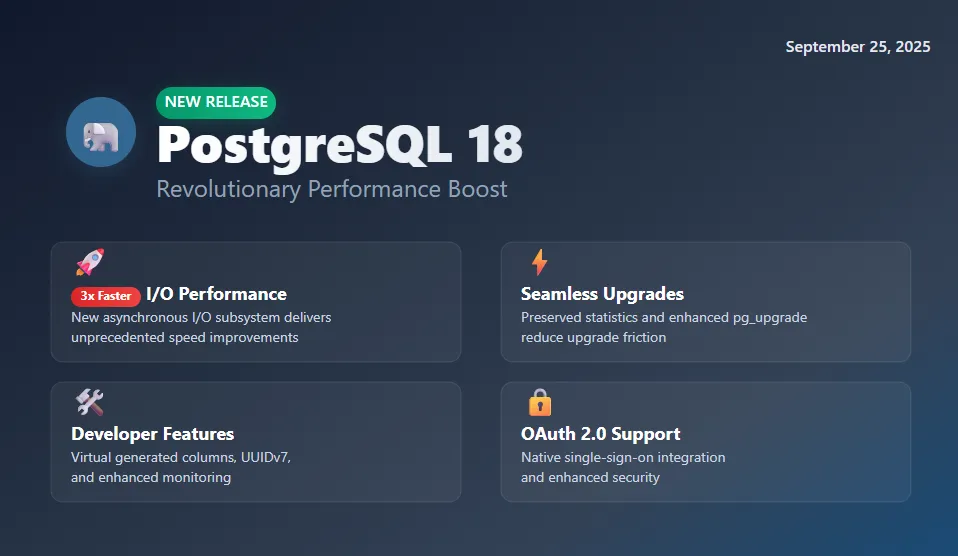
The PostgreSQL Global Development Group has released PostgreSQL 18, delivering the most significant performance improvements in recent years. This latest version transforms database I/O operations and streamlines the upgrade experience for organizations worldwide.

PgManage 1.3.1: Enterprise Edition Released

PgManage 1.3.1 is now available with fixes across PostgreSQL, Oracle, MariaDB, and SQLite3, plus updated dependencies and UI refinements. Learn what’s new and explore PgManage Enterprise Edition with remote access, multi-user support, and OAuth2 integration.

Upgrading PostgreSQL and Citus for Enhanced Database Functionality

Upgrading PostgreSQL and Citus for Enhanced Database Functionality

Discover how a client successfully upgraded PostgreSQL 11 to 15.5 and Citus 8.3 to 12.1 while simplifying extensions, improving scalability, and enhancing performance. This real-world case study highlights the planning, testing, and expertise required to achieve seamless upgrades in distributed environments.