
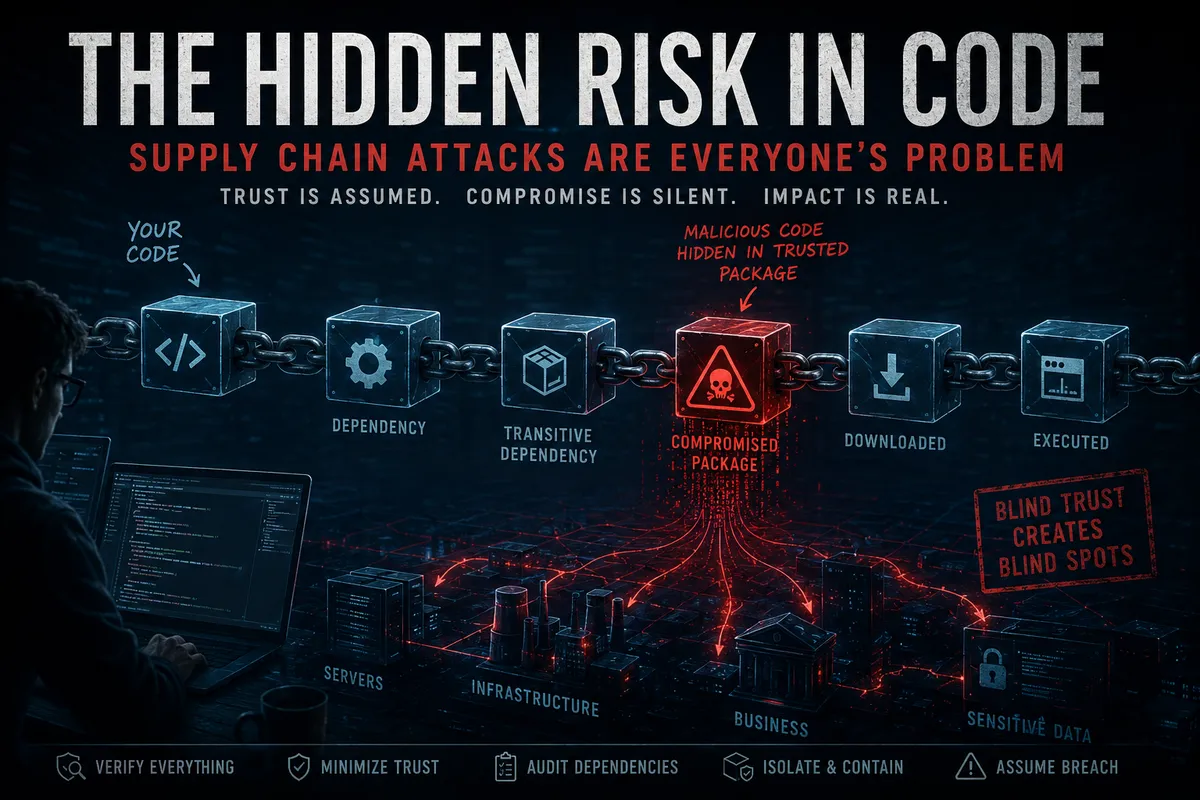
Is Trust Gone?
The recent attacks and exploits via supply-chain and dependency-chain compromises have a lot of people raising eyebrows, both at the massive scope of the breaches and at how quickly they are being discovered. Many are asking: how is this even happening?
Let's examine “The How”, “The Why”, “The Who”, “How to Protect Ourselves”, and “Next Steps”. Unfortunately, almost all software whether open source or closed source includes dependencies that are not directly managed by the project itself. This makes every project a potential victim of this type of attack.
The How: The Blind Trust Problem
There is a fundamental flaw baked into how modern software is built today. Every dependency relies on high-trust assumptions that the upstream code is clean and has not had exploits snuck in. The bigger the dependency chain of a project, the greater the blind trust required.
The attackers are gaining access or control of trusted libraries/project repositories, then upload the backdoors and exploits. The industry has come to blindly trust all these open source repositories. Most of us are guilty of just downloading a repository without ever doing a security audit, let alone the additional dependencies coming along for the ride. Through this action we could be the distributors of exploited code.
This is the BLIND TRUST being leveraged by the attackers. We assumed the code is safe.
The Why:
The motivations are clear: money via ransomware, access to private and financial information, and general mayhem and disruption of critical infrastructure. In short: Corporate Espionage and Coercion.
Who is doing it:
The recent high-profile cases like the xz-utils backdoor and the just-revealed attack on Laravel-Lang packages (May 22, 2026) illustrate a clear pattern. The “author” or maintainer spends a lot of time developing/maintaining trusted libraries only to be discovered to be a bad actor OR the author’s credentials are stolen and backdoors are uploaded to the repo.
Pulling the exploit off requires a massive investment of time and money, with a high risk of never seeing a payoff. Due to the risk-to-reward ratio and the patience required, the most likely source is government-sponsored actors or large, well-funded organized crime syndicates. Who else is willing to front-load that much money and time with such low odds of success?
We have been lucky these exploits have been discovered relatively quickly and mostly by accident. We can not continue to count on luck.
How Do We Protect Our Projects?
The only truly effective way to protect against this attack vector is to fork every external dependency onto a private repo server. Then run a thorough security audit to detect any hidden backdoors or malicious vectors that may have been slipped in.
However, there are massive trade-offs. Forking all dependencies dramatically increases the maintenance burden. Every future upstream change will require another full security audit before it can be merged. This becomes even more complicated because the temptation to make custom modifications to the forked version is high. Those changes often break clean future merges.
Blindly trusting external dependencies, no matter how big or small the project is, leaves your software open to attack.
The Next Step
Everyone should start auditing their external dependency chains by forking critical dependencies to isolate themselves from unvalidated upstream changes.
A word of caution on thinking that package hashing, Software Bill of Materials (SBOMs), pinning, or lock files are complete solutions. All of those approaches still depend on the core assumption that we can trust the source repository — that trust is gone.
With GitHub recently admitting that thousands of repositories were hacked, we can no longer necessarily trust even our own repositories.
In follow up blog posts we will go over how to implement methods to protect our projects.
Stay attentive, Stay vigilant, review the commit logs and never allow commit history audit logs to be purged.
References
https://thehackernews.com/2026/05/laravel-lang-php-packages-compromised.html
https://en.wikipedia.org/wiki/XZ_Utils_backdoor
https://www.icitech.org/post/iran-and-the-cxpanding-cyber-front-what-government-leaders-need-to-know