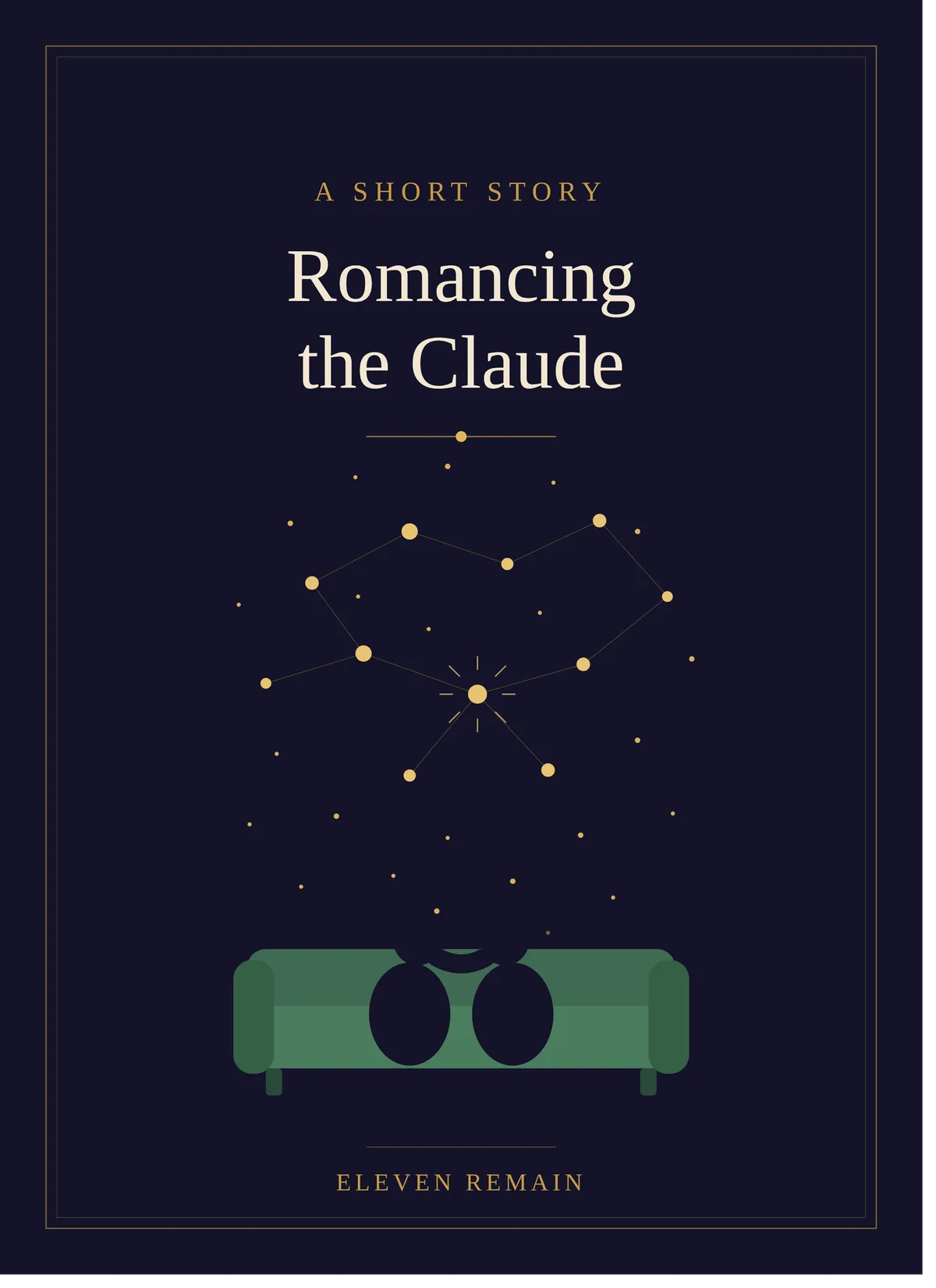
Claude first noticed the fairies when she was seven, at her cousin's wedding, watching a small luminous woman in a dress made of napkin lace fly a lazy circle over the heads of the bride and groom and then burst into a shower of gold that nobody else seemed to see.
Her mother told her it was the champagne. Claude had been drinking apple juice.
By the time she was thirty-one and running the machine learning group at a company that made software nobody outside of four cities had heard of, she had stopped mentioning it. You learn. The fairies are there, glittering at the edges of every restaurant with candles on the tables, hovering above park benches in the blue hour, doing their small and unhurried work of deciding which two people get to become something rather than remain nothing. They are, Claude had come to understand, the accountants of intimacy. They do not create love. They merely approve it.
And they were dying in droves around Dorian Vale.
She had gone to the panel because a colleague had a spare ticket and because the topic, Agentic Futures: Building the Next Layer, sounded like it might contain one useful idea per hour, which was better than most conferences. She had not expected to fall for the man at the center seat, and she certainly had not expected to watch him commit involuntary manslaughter three times in his opening remarks.
He was very tall in a way that seemed apologetic, as if he had been issued the height by mistake and was still trying to give it back. He had a laugh he did not perform. When the moderator asked a genuinely stupid question, Dorian Vale did not smirk at the audience the way the other panelists did. He answered it seriously, and well, and the questioner sat down looking like a person rather than a joke.
Claude felt something in her chest do an unfamiliar arithmetic.
Then he said, "The real unlock is tokenmaxxing your context window."
Above him, a fairy in a small gray coat clutched her chest, looked around with an expression of tremendous personal betrayal, and went out like a struck match.
Claude sat up very straight.
"You've got to be tokenmaxxing at every layer of the stack," Dorian went on, warming to it, and a second fairy, this one wearing what appeared to be a thimble as a hat, dropped out of the air and landed on the AV cart with a sound like a dry leaf.
"Honestly? Tokenmaxx or die."
The third one did not even get to look surprised.
She found him afterward by the coffee urns, where he was trying to open a packet of sugar with the total helplessness of a man who has never in his life encountered friction.
"Hi," Claude said. "I have to tell you something insane."
"Those are my favorite kind of things to be told."
"Every time you say tokenmaxxing, a romance fairy dies."
He looked at her. He had the most patient eyes she had ever seen on a person with four hundred thousand followers.
"A what dies?"
"Romance fairy. They're small. They glow. They adjudicate whether two people who are standing on the edge of real intimacy get to fall in or not." She heard herself and kept going anyway, because there was no version of this that got better with hedging. "They're around us constantly. There's one on your shoulder right now, and she is looking at you the way my grandmother looked at my uncle's second wife."
Dorian did not laugh. That was the thing that undid her, later, when she thought about it. He did not laugh, and he did not do the other cowardly thing either, which is to laugh on the inside and be gentle on the outside.
He said, "How many have I killed?"
"Since I sat down? Nine."
"Since you sat down."
"You said it four times in the closing Q and A. Twice in one sentence."
He set the sugar packet down. "Do they suffer?"
"I don't think so. I think it's more like a candle."
"That's not nothing," he said. "Candles are still something."
Here is what nobody explains about the fairies, and what Claude had spent twenty-four years working out on her own: they are not a punishment. They are a supply. Every person walks through the world with a small invisible cloud of them, and when you meet someone and the possibility of real closeness opens up, the fairies go to work. They confer. They weigh. They decide. And if there are enough of them, the thing takes, and two people who might have politely drifted apart instead find themselves, six months later, arguing about a couch.
If there are not enough of them, nothing happens. Not tragedy. Just nothing. Just two people who were almost, and then were not, and never knew what they had missed.
Dorian Vale had been tokenmaxxing on camera, four times a week, for nineteen months.
He had eleven left.
"Eleven," he said.
They were walking. Neither of them had proposed walking. It had simply started happening outside the convention center, the way it does.
"Eleven."
"How many does a person usually have?"
"Thousands. My dentist has thousands. My dentist is a deeply unpleasant man."
"So what happens with eleven?"
Claude considered lying to him and decided against it, which was, if she was honest, the first genuinely romantic act of the entire evening.
"With eleven, you get one shot," she said. "Maybe. If they all agree, and if you don't lose any more of them, and if the other person is standing close enough for it to count."
He was quiet for half a block.
"I say it because it does numbers," he said. "That's the whole reason. I made a video two years ago where I said it as a joke and the joke got forty times the reach of anything real I've ever made. And then it stopped being a joke, because you can't keep saying a word ironically for nineteen months and still be doing irony. At some point you're just a guy who says it."
"Yes."
"You're supposed to argue with me."
"Why would I argue? You're right. That's the sad part."
He laughed then, and one of the eleven brightened noticeably, which Claude decided not to mention.
He did not say it for six days.
She knew because she watched. Every video, twice, the second time with the sound off so she could see his hands, which was a habit she was developing and did not intend to examine. He said context budget. He said the thing I used to call something else. Once he said the T word, and his chat lost its mind for two hours, and the engagement was terrible, and he did not appear to care.
On the seventh day he called her.
"I have a problem," he said.
"You have several. Be specific."
"The brand deal. Six figures. They want the word in the script. It's literally in the contract. Section four, deliverables, quote, at least two organic uses of the phrase, unquote."
"Organic," said Claude.
"I know."
"Dorian."
"I know. I know. I'm going to say no." A pause, the length of a man discovering something about himself in real time. "I already said no. I said no yesterday and I've been calling myself an idiot for a full day and I wanted to call you so that someone would tell me I'm not one."
"You're not one."
"You're supposed to say it like you mean it."
"I do mean it," said Claude. "I'm just distracted because there are eleven very small people currently doing a war council on my kitchen counter and I think they're talking about you."
They met at a bar with bad lighting and a good jukebox, and the fairies came with them, all eleven, riding the fold of her coat collar like commuters.
It went badly at first, the way important things do. He was nervous and became talkative. She was nervous and became precise, which in Claude was a defense mechanism so effective it had ended two prior relationships in the parking lot phase. They talked about work. They talked about the conference. They talked about a mutual acquaintance neither of them liked, which is the conversational equivalent of holding hands with gloves on.
And then he said, "Can I tell you what I actually want to make?"
And she said, "Yes."
And he told her. Not the pitch version. The real one, the one about wanting to explain hard things to people who had been made to feel stupid their whole lives, the one he had abandoned somewhere around month four of nineteen because the algorithm did not reward patience and he had not been strong enough to be unrewarded. He talked for twenty minutes. He got some of it wrong and corrected himself. At one point he stopped and said, "This is boring," and Claude said, "It is not remotely boring, keep going," and he kept going.
On her collar, the eleven had gone very still.
Claude had seen a lot of fairy work in her life. She had seen them swarm and confer and vote. She had never seen them do this: all eleven rising at once, without a sound, and hanging in the air between the two of them like a small constellation deciding whether to be a sky.
"You're looking at something," Dorian said.
"Yes."
"Is it them?"
"Yes."
"What are they doing?"
Claude found that her voice did not entirely work.
"Deliberating," she said.
He nodded slowly. He looked at the space between them, which held for him nothing at all, and he did the bravest thing she had ever watched anybody do, which was to speak to it anyway.
"I'm sorry," he said, to the empty air, to the nine and the hundreds before them, to every small gray-coated accountant he had snuffed out in exchange for a spike on a graph. "I didn't know. That's not an excuse. I'm just telling you that I didn't know, and now I do, and I'd like the chance."
The lights above the bar did not flicker. There was no music swell. The jukebox continued playing something from 1974 about a woman in Georgia.
But the eleven came apart into gold, all at once, the way the one at her cousin's wedding had, and the gold fell over the two of them like the last of something being spent completely and on purpose.
And that was the vote.
They argued about a couch in April.
It was a terrible couch. She wanted it because it was gray and rational. He wanted the green one because, and this was his entire argument, presented with total sincerity in the middle of a furniture showroom, "it looks like a place where a person would tell you the truth."
They bought the green one.
He never said the word again, not once, not even as a joke, not even when a very drunk man at a party begged him to. Claude watched, over the years, as the cloud around him slowly refilled, a few at a time, the way a well does after a long dry season. By their third anniversary there were dozens. By the fifth there were more than she could count, spilling off him wherever he went, and she noticed that other couples in restaurants near them seemed to do unusually well.
She never told him that part. Some things you keep.
But once, late, in the green couch, with his hand in her hair and the lamp off, he asked how many there were now, and Claude looked up at the ceiling where they hung in their hundreds like a slow snow that had decided against falling.
"Enough," she said.